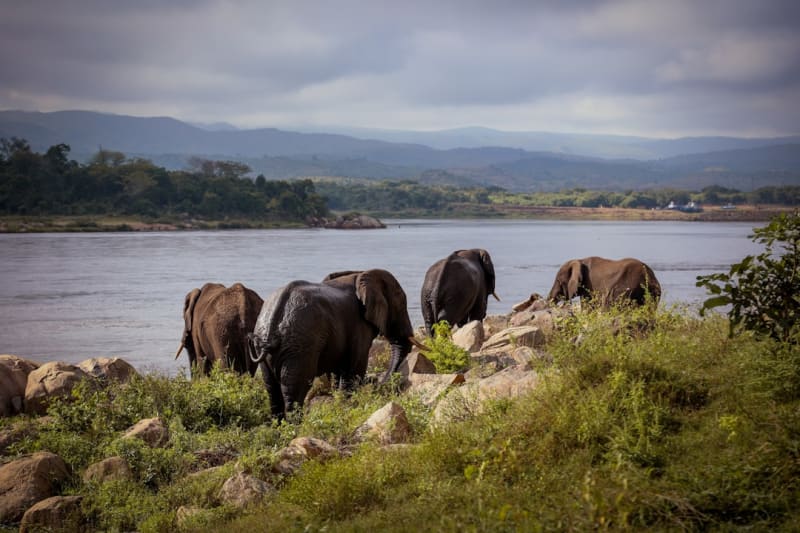
African Elephant Conservation in Rwanda: 2026 Status

Rwanda’s African elephants survive in small, fragmented populations, including Akagera and the Virunga landscape. Conservation priorities in 2026 are habitat protection, human-elephant conflict reduction, cross-border law enforcement and better monitoring.
Last reviewed August 2026. Conservation data changes — see the cited sources for the latest figures.
Quick answer: what is the status of African elephants in Rwanda in 2026?
Rwanda’s African elephant population is small compared with the country’s better-known mountain gorilla population, and the available research does not provide a reliable, current national total. Historical surveys recorded elephants in Akagera National Park, Volcanoes National Park and Nyungwe Forest, while more recent conservation work has focused particularly on monitoring elephants and reducing conflict in Volcanoes National Park [1][2].
Rwanda’s elephants face the same continent-wide pressures identified by the IUCN: habitat conversion, fragmentation, ivory poaching and conflict with people. The most credible continental estimate available in the research is around 415,000 African elephants combined in the 2016 IUCN African Elephant Status Report; the IUCN classifies the African savanna elephant as Endangered and the African forest elephant as Critically Endangered [3].
Why elephant conservation matters in Rwanda
Rwanda is a small, densely populated, landlocked country whose protected areas are important refuges for large mammals. Its three national parks include Akagera’s savanna landscapes, the montane forests of Volcanoes National Park and the forests of Nyungwe and Gishwati-Mukura [4][5].
Elephants are one of the large mammals associated with Akagera National Park, alongside black rhinoceroses, hippos and giraffes [5]. Their presence contributes to the ecological character that makes a wildlife safari park valuable: elephants open pathways, alter vegetation and create habitat used by other species. However, the research supplied for this article does not quantify the precise ecological effects of Rwanda’s elephant population, so those functions should be understood as general elephant ecology rather than a measured result from a specific Rwandan park.
Rwanda’s elephant history also illustrates how quickly a small population can become vulnerable. A historical IUCN report stated that approximately 140 elephants were present in Rwanda in 1973 in two isolated populations surrounded by human settlements. Following increasing human-elephant conflict, adults were killed in a government operation and juveniles were translocated to Akagera; 26 animals were successfully released to form the nucleus of a new population [1]. The report’s figures are historical and should not be treated as a 2026 census.
The same report recorded a 1994 estimate of 39 elephants in Akagera, with additional possible or speculative records bringing the national total to 84 in its summary. It also listed estimated animals in Volcanoes and Nyungwe, but the report itself described uncertainty in some categories [1]. These old data show why current, standardised monitoring matters: small changes can be significant, yet an apparent change may also reflect better survey coverage.
Which African elephant species occur in Rwanda?
The IUCN now recognises two African elephant species. The African savanna elephant (Loxodonta africana) is listed as Endangered, while the African forest elephant (Loxodonta cyclotis) is listed as Critically Endangered [3]. The research confirms that savanna elephants occur in Rwanda’s wider range, but it does not establish a current species-level breakdown for Rwanda itself [6].
This distinction matters because conservation planning should reflect habitat and population differences rather than treating every African elephant as one uniform population. Rwanda’s savanna environment in Akagera differs substantially from the forests and highland habitats associated with the country’s western protected areas [4][5].
The main threats to elephants in Rwanda
1. Habitat loss and fragmentation
Habitat conversion for agriculture and other land uses is a major threat to African elephants across the continent, according to the IUCN [3]. In Volcanoes National Park, the International Elephant Foundation reports that elephant habitat has been threatened by encroachment and clearing for human use, leaving only a small percentage of the animals’ former range [2].
Fragmentation is especially serious in a densely settled country. When elephants are confined to smaller areas, their movements can bring them into contact with farms and households. The available research does not provide a 2026 measurement of habitat lost in Rwanda or a national map of elephant range, so the scale of the countrywide problem should not be overstated.
2. Human-elephant conflict
In Volcanoes National Park, neighbouring communities have largely regarded elephants as pests, according to the International Elephant Foundation’s project report [2]. Crop-raiding can damage food supplies and household livelihoods, while fear and frustration can undermine local support for protected areas. The project therefore combined elephant monitoring with conservation awareness in border communities, on farms and in primary schools [2].
Conflict is not only a wildlife issue. It is a question of land use, food security, safety and whether communities receive credible benefits from living beside a national park. Conservation responses that focus only on patrols, without addressing local concerns, are unlikely to be durable.
3. Ivory poaching and trafficking
Poaching increased sharply across Africa after 2008 and peaked in 2011, although it continues to threaten elephant populations, the IUCN says [3]. Ivory trafficking is inherently transboundary, making cooperation between neighbouring countries essential. A U.S. Fish and Wildlife Service project summary described work in the Greater Virunga Landscape involving Rwanda, Uganda and the Democratic Republic of Congo to improve collaboration between park authorities, reduce cross-border poaching and trafficking, and strengthen law-enforcement cooperation [7].
The research provided does not give a verified 2026 number of elephants poached in Rwanda, nor does it report a Rwanda-specific poaching reduction. Claims that patrols or technology have eliminated the threat would therefore be misleading.
4. Climate and changing resources
Climate change can alter water availability, vegetation and the timing of resources used by elephants. However, the supplied Rwanda-specific sources do not quantify climate-driven changes in elephant habitat or conflict in 2026. It is more accurate to identify climate variability as a management concern than to attach an unsupported percentage or forecast to its effect on Rwanda’s elephants.
What is being done to conserve elephants?
Monitoring in Volcanoes National Park
The International Elephant Foundation supported a monitoring and conservation project in Volcanoes National Park during 2018–2019 and 2021, in partnership with the Rwanda Development Board [2]. Rangers received training in elephant monitoring and modern data-collection techniques. The resulting information was intended to improve understanding of elephant movements and resource use, helping managers reduce crop-raiding [2].
The project also supported conservation education in communities near the park and established eco-clubs in primary schools [2]. This is important because conflict prevention depends on both practical information—where elephants move and when—and longer-term attitudes among the next generation.
Greater Virunga cooperation
The Greater Virunga Landscape crosses Rwanda, Uganda and the Democratic Republic of Congo. The U.S. Fish and Wildlife Service’s African Elephant Program Summary described support for transboundary collaboration, improved coordination between law-enforcement and protected-area authorities, and measures to reduce ivory trafficking [7].
Transboundary conservation is necessary when wildlife movements and criminal networks cross national borders. It also creates practical challenges: park authorities must share information, coordinate investigations and maintain compatible approaches despite different institutions and security conditions. The research identifies the collaboration as a conservation intervention but does not provide a current Rwanda-specific outcome measure.
Protected-area management and law enforcement
Rwanda’s national parks are managed within a national conservation system, with the Rwanda Development Board named as a partner in the Volcanoes elephant-monitoring project [2]. More broadly, elephant conservation requires ranger patrols, intelligence, evidence handling, judicial cooperation and reliable wildlife monitoring. African Parks describes these tools—including rangers, canine teams, communications technology, wildlife monitoring and judicial-system support—in its wider conservation partnerships, but the supplied source does not establish that every listed intervention operates in Rwanda [8].
For a broader look at wildlife protection, SafariFind’s guide to anti-poaching in Rwanda provides relevant national context. Elephant-specific results should still be checked against specialist sources because general wildlife-crime data do not automatically describe elephant populations.
Community conservation and the role of tourism
Tourism can help make protected areas economically and politically valuable, but its benefits are not automatic. A responsible wildlife safari creates demand for guides, drivers, accommodation, park operations and conservation services. In Rwanda, tourism also brings visitors to landscapes where elephants share space with farmers and other wildlife. The supplied research does not provide a verified percentage of safari fees that reaches elephant conservation in Rwanda, so travellers should ask operators and parks how payments are allocated rather than assuming that every booking has the same impact.
Visitors to Volcanoes National Park should understand that the park is not simply a gorilla destination. It also contains elephant habitat where monitoring and conflict reduction remain relevant [2][5]. Gorilla trekking is regulated and conservation-sensitive, but a gorilla permit should not be described as direct elephant funding without evidence. Travellers comparing experiences can read SafariFind’s guide to Volcanoes National Park gorilla trekking, while recognising that gorilla tourism and elephant conservation are related parts of a wider protected-area economy rather than interchangeable programmes.
In Akagera, elephants are part of the savanna wildlife experience described in national and geographic references [4][5]. Planning a safari in the park can support the broader protected-area economy, but the research supplied here does not document an elephant-specific tourism levy or programme result. SafariFind travellers can book conservation-supporting safaris on SafariFind after checking the operator’s claims, community partnerships and financial transparency.
Results and setbacks: what the evidence really shows
| Area | What the research shows | What remains uncertain |
|---|---|---|
| Historical population | A 1994 IUCN report summarised 39 definite elephants, 32 possible and 10 speculative records for Rwanda [1]. | This is not a current population estimate and includes uncertain categories. |
| Volcanoes monitoring | Rangers were trained in monitoring and data collection, with the goal of understanding movements and reducing crop-raiding [2]. | No verified 2026 population total or quantified conflict reduction is provided. |
| Regional protection | Greater Virunga partners were supported to improve cross-border anti-poaching and trafficking cooperation [7]. | The supplied project summary does not report a Rwanda-specific outcome figure. |
| Continental context | The IUCN reports severe declines: savanna elephants fell by at least 60% over 50 years and forest elephants by more than 86% over 31 years [3]. | Continental trends cannot be used as a direct Rwanda census. |
The positive story is that Rwanda’s conservation authorities and partners have invested in monitoring, community education and regional cooperation. The setback is the limited public evidence in the supplied research for a current, nationally comparable elephant census. Conservation success cannot be demonstrated confidently without consistent counts, movement data, conflict records and transparent reporting.
How travellers can help responsibly
- Choose credible operators. Ask whether guides follow park rules, discourage wildlife disturbance and explain how conservation and community benefits are generated.
- Keep a safe distance. Do not pressure a guide to approach elephants, block their route or encourage risky close encounters for photographs.
- Never buy ivory or wildlife products. Ivory trafficking remains a recognised continental threat [3][7].
- Respect farms and communities. Rural residents living beside protected areas bear real costs when wildlife damages crops. Avoid treating conflict as entertainment.
- Support longer-term conservation. Consider reputable organisations that publish their partners, project dates and outcomes, such as the International Elephant Foundation’s Rwanda project with the Rwanda Development Board [2].
- Ask precise questions. A responsible tourism claim should identify the park, implementing organisation, type of support and evidence of results—not rely only on generic promises.
Rwanda offers a valuable lesson in conservation: protecting a small elephant population requires more than stopping poachers. It requires accurate monitoring, secure and connected habitat, practical solutions for crop-raiding, accountable institutions and tourism that respects the people who live beside wildlife.
Frequently Asked Questions
How many elephants are there in Rwanda in 2026?
The research supplied does not provide a reliable 2026 national elephant census. A historical IUCN report summarised 39 definite, 32 possible and 10 speculative records in Rwanda in 1994, but those figures are too old and uncertain to represent today’s population [1].
Where can you see elephants in Rwanda?
Elephants are associated with Akagera National Park, and conservation research also discusses elephants in Volcanoes National Park. National geographic references identify Akagera as home to elephants, while the International Elephant Foundation reports monitoring work in Volcanoes [2][5].
What are the main threats to African elephants in Rwanda?
The main threats are habitat encroachment and clearing, human-elephant conflict and ivory poaching. The IUCN identifies habitat conversion and poaching as major continental threats, while Rwanda-specific research highlights crop-raiding concerns in Volcanoes National Park [2][3].
Are African elephants endangered in Rwanda?
African elephants are not assessed as one single species by the current IUCN framework. African savanna elephants are Endangered and African forest elephants are Critically Endangered; the supplied sources do not give a separate current Red List assessment for Rwanda’s elephants [3].
What is being done to protect elephants in Rwanda?
Conservation measures include ranger training, elephant movement monitoring, community education, school eco-clubs and transboundary cooperation against poaching and trafficking. The International Elephant Foundation worked with the Rwanda Development Board in Volcanoes National Park, while Greater Virunga partners have supported regional law-enforcement cooperation [2][7].
How does tourism help elephant conservation in Rwanda?
Tourism can support the wider protected-area economy, jobs and conservation services, but the supplied research does not document a verified elephant-specific share of Rwanda safari fees. Travellers should ask operators how conservation and community benefits are allocated.
What should I do if I see an elephant on safari in Rwanda?
Remain quiet, follow the guide’s instructions, keep the vehicle at a safe distance and never block the elephant’s route or encourage a closer approach for photographs. Respectful viewing reduces disturbance and supports safer wildlife tourism.
What is the difference between a savanna elephant and a forest elephant?
The IUCN recognises them as two African elephant species. Savanna elephants are assessed as Endangered, while forest elephants are assessed as Critically Endangered [3]. The supplied research does not provide Rwanda’s current species-level population breakdown.
How does Rwanda compare with other African safari destinations for elephant viewing?
Rwanda has elephant habitat in Akagera and documented elephant-monitoring work in Volcanoes, but the supplied research does not provide comparable 2026 population or viewing statistics for Rwanda versus South Africa or other destinations [2][5].
How can I support elephant conservation after visiting Rwanda?
Choose a transparent operator, follow park rules, refuse ivory and wildlife products, and support reputable conservation organisations that identify their partners and project results. The International Elephant Foundation’s Rwanda work with the Rwanda Development Board is one documented example [2].