Vulture Conservation in Burundi (2026): Status & Threats
African vultures face catastrophic population declines across the continent, including in Burundi, driven by poisoning, habitat loss, and belief-based trade. Community-led restoration and transboundary initiatives offer hope.
Vulture Conservation Status in Burundi: The Quick Answer
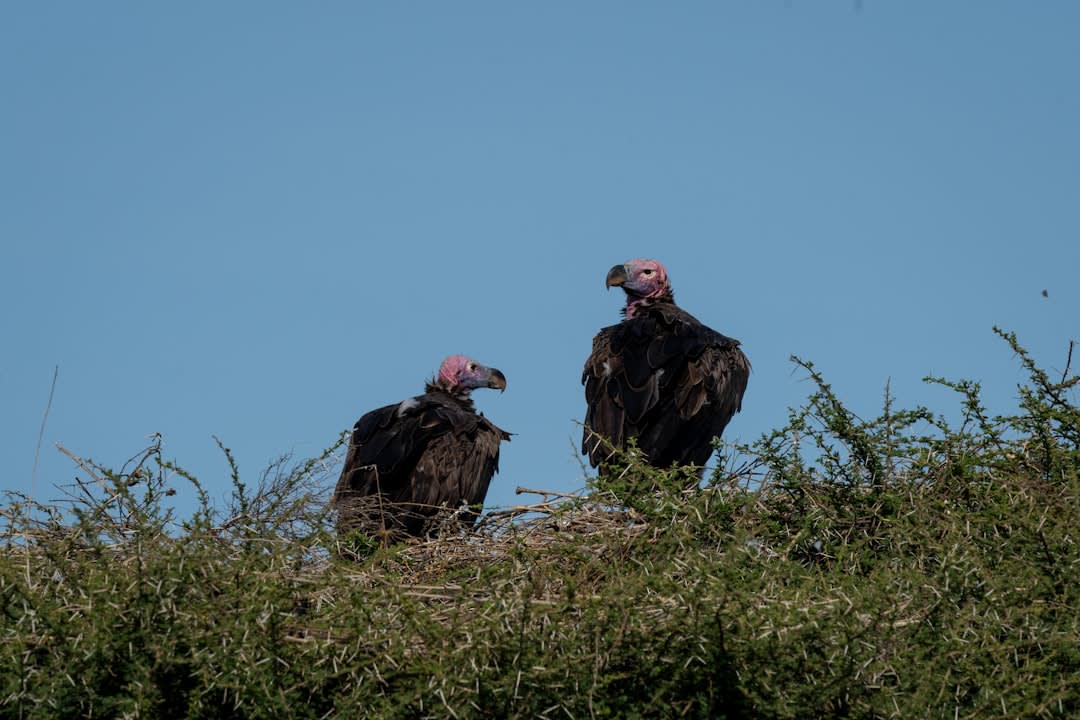
Vultures across Africa, including species that range through Burundi, are in crisis. White-backed vultures have declined up to 81% over 40 years, while Rüppell's vultures have crashed by 92.5% in the same period.[1] In December 2025, both species were uplisted to CITES Appendix I—the highest international protection level—effectively banning commercial trade.[1] Burundi is part of a transboundary conservation landscape where local partners are working to restore degraded habitats and engage communities in protection efforts, yet funding and capacity remain critical bottlenecks.
Why Vulture Conservation Matters in Burundi
Vultures are nature's essential sanitation crew. A single vulture can consume a carcass that would otherwise decompose slowly, preventing the spread of diseases like anthrax and rabies to livestock and human populations.[2] Without vultures, feral dog populations have expanded in other regions, amplifying rabies transmission risk.[3] Across Africa, 11 of the world's 23 vulture species occur, yet nearly half of all vulture species globally are now endangered or critically endangered.[4]
In the Great Lakes region of East Africa—which includes Burundi, Uganda, Rwanda, and Tanzania—vultures and other threatened birds inhabit wetlands and open woodlands that have undergone severe degradation. The region is recognised as a critical biodiversity hotspot, and vulture populations here face converging threats from habitat loss, poisoning, and illegal trade.[5]
Key Vulture Species in Burundi and the Region
While the research does not provide species-specific population counts for Burundi alone, the following African vulture species occur across the East African region and face critical threats:
- White-backed Vulture (Gyps africanus): Estimated decline of 81% over 40 years across Africa.[1] Critically endangered; widespread but undergoing rapid declines.
- Rüppell's Vulture (Gyps rueppellii): Estimated decline of 92.5% over 43 years.[1] Critically endangered across its range.
- Hooded Vulture (Necrosyrtes monachus): Critically endangered; fewer than 100 breeding pairs remain in some regions.[4]
These species are migratory or nomadic, ranging across borders, making conservation inherently transboundary in nature.
Primary Threats to Vultures in Burundi and East Africa
Poisoning: The Leading Killer
Poisoning—both accidental and intentional—is the most significant threat to vultures across their range.[6] Farmers poison carcasses to kill predators, but vultures that feed on poisoned livestock die in mass events. Veterinary non-steroidal anti-inflammatory drugs (NSAIDs) like diclofenac, used to treat livestock in Asia and increasingly documented in Africa, are lethal to vultures even in tiny residual amounts in carrion.[3]
Belief-Based Use and Illegal Trade
Trade in vulture body parts for traditional medicines and belief-based practices accounts for approximately 29% of vulture deaths across Africa.[7] Vultures are hunted for skulls, feathers, and organs believed to bring good fortune or possess medicinal properties.[1] The December 2025 CITES Appendix I uplisting of white-backed and Rüppell's vultures now prohibits international commercial trade, yet regional and domestic trade continues illegally.[1]
Habitat Loss and Degradation
Conversion of woodlands and grasslands for agriculture, settlement, and infrastructure removes nesting and foraging habitat. Fragmentation of remaining populations isolates breeding groups and reduces food availability as large mammal populations decline.[6]
Electrocution and Collision
Vultures collide with power lines and wind turbines, and are electrocuted on uninsulated electricity infrastructure—threats that are increasing as infrastructure development expands across Africa.[6]
Conservation Actions Underway in Burundi
Habitat Restoration and Community Engagement
The most concrete conservation work documented in Burundi is led by Association Burundaise pour la protection de la Nature (ABN), a BirdLife International partner. ABN implements the Kibira Peace Sanctuary and Nature Conservation project, funded by the United Nations Capital Development Fund as part of a five-organisation consortium in northwestern Burundi.[8] In 2023, ABN restored over 20 hectares of Kibira forest with African Cherry (Prunus africana) and demarcated 13 km of restored area. An additional 15 km of common bamboo was planted to protect riverbanks, and a 20 km watershed was developed.[8]
While this project is primarily focused on forest restoration and livelihoods improvement, the habitat recovery directly benefits vultures and other bird species by increasing available nesting sites and supporting the ecosystem health that sustains carrion food sources.
Transboundary Monitoring and Community Champions
The Denver Zoo Conservation Alliance (DZCA) supports the Rwanda Wildlife Conservation Association's (RWCA) Community Conservation Champions (CCC) programme, which operates across Rwanda, Uganda, Tanzania, and Burundi.[5] The CCC comprises 52 local community members employed as monitors and educators in key crane and wetland hotspots.[5] Although this initiative focuses primarily on endangered Grey Crowned Cranes, the community champions' work on wetland conservation and species monitoring creates a foundation for broader bird conservation, including vultures that use similar habitats.[5]
International Policy and Trade Protection
In December 2025, Burundi, as a CITES member state, participated in the decision to uplift white-backed and Rüppell's vultures to Appendix I.[1] This provides legal backing for enforcement against international trafficking, though implementation depends on national capacity and political will.
Regional Multi-Species Action Plan Framework
The Vulture Multi-species Action Plan (Vulture MsAP), adopted in 2017 and covering 15 African-Eurasian vulture species, provides a strategic framework for halting population declines and reversing trends.[6] The plan calls for governments to develop National Vulture Conservation Action Plans, coordinate across sectors (agriculture, livestock, public health), and secure long-term funding.[6] Burundi, as a signatory to the Convention on Migratory Species (CMS), is part of this framework, though the research does not document a Burundi-specific national action plan as of August 2026.
Funding and Capacity Challenges
Between 2017 and 2023, at least USD 64.7 million was invested in vulture-specific conservation projects across the entire Vulture MsAP range.[9] However, funding distribution is highly uneven. East Africa received only 2% of the total (approximately USD 1.4 million), with 90% of that invested in Tanzania.[9] Burundi and other smaller range states receive minimal dedicated funding. The primary limiting factors identified by conservation stakeholders are:
- Insufficient financial resources for long-term implementation[9]
- Lack of implementation capacity in government and NGO partners[9]
- Limited political will and engagement at national level[9]
Tourism and Community Support for Conservation
Wildlife tourism on conservation-focused safaris in Burundi can generate revenue that supports habitat protection and community employment. While Burundi's tourism sector has historically been constrained by security and infrastructure challenges, responsible tourism that prioritises community benefit and conservation outcomes can strengthen local incentives for protection. Visitors booking through platforms like SafariFind can select operators committed to funding ranger patrols, habitat restoration, and community education programmes.
Community engagement is non-negotiable for vulture conservation. Traditional healers and local communities must understand the ecological and economic value of living vultures, and be offered alternatives to belief-based use. BirdLife's approach in Tanzania's Mara-Serengeti ecosystem—engaging traditional healers directly to reduce vulture killings for traditional medicine—offers a model applicable to Burundi.[7]
Successes and Ongoing Challenges
Successes
- International policy win: The December 2025 CITES Appendix I uplisting of white-backed and Rüppell's vultures provides the strongest legal framework yet to combat international trafficking.[1]
- Habitat restoration momentum: ABN's work in Kibira demonstrates that community-led restoration is feasible and achieving tangible results, with trees growing well and community buy-in evident.[8]
- Transboundary frameworks: The Community Conservation Champions programme and the broader Vulture MsAP create coordination mechanisms across Burundi and neighbouring countries, addressing vultures' migratory nature.[5]
Remaining Challenges
- Funding gap: East Africa's 2% share of global vulture conservation funding is grossly inadequate relative to the scale of species decline and the region's conservation needs.[9]
- Belief-based use persists: Despite international trade bans, regional and domestic killing for traditional beliefs continues, requiring sustained community engagement that is under-resourced.[1]
- Habitat loss acceleration: Agricultural expansion and infrastructure development in Burundi and the region continue to fragment vulture habitat.[6]
- Limited national action: The research does not document a dedicated National Vulture Conservation Action Plan for Burundi as of August 2026, suggesting the country has not yet mobilised a comprehensive, coordinated response.
- Livestock poison risk: As NSAIDs and other veterinary drugs become more available in East Africa, accidental poisoning of vultures through livestock carcasses is an emerging and under-monitored threat.[3]
How You Can Support Vulture Conservation in Burundi
- Book responsible safaris: Choose conservation-certified operators that commit a portion of revenue to habitat protection and community programmes.
- Support transboundary initiatives: Donate to or volunteer with organisations like the Rwanda Wildlife Conservation Association that work across Burundi, Rwanda, Uganda, and Tanzania.
- Advocate for policy: Encourage your government to support CITES enforcement and fund the Vulture MsAP implementation in East Africa.
- Reduce veterinary drug harm: If you work in agriculture or livestock, promote NSAID-free alternatives and proper disposal of livestock remains.
- Spread awareness: Educate communities and tourists about vultures' ecological role and the consequences of belief-based killing.
Last reviewed August 2026. Conservation data changes — see the cited sources for the latest figures.
Frequently Asked Questions
What is the current population status of vultures in Burundi?
The research does not provide Burundi-specific vulture population figures. However, across Africa, white-backed vultures have declined 81% over 40 years and Rüppell's vultures have declined 92.5% over 43 years.[1] These species range through Burundi and the East African region. All major African vulture species are either endangered or critically endangered, and populations continue to decline across their ranges.
Why are vultures so important to ecosystems?
Vultures are nature's sanitation system. They consume carrion that would otherwise decompose slowly, preventing the spread of diseases like anthrax and rabies to livestock and humans. In regions where vultures have been eliminated, feral dog populations have expanded, actually increasing disease transmission risk.[2][3] Without vultures, ecosystem health and public health both suffer.
What is the biggest threat to vultures in Burundi?
Poisoning is the leading cause of vulture death across Africa.[6] This includes both intentional poisoning of carcasses by farmers trying to kill predators, and accidental poisoning from veterinary drugs like NSAIDs that remain in livestock carrion. Belief-based use and illegal trade for traditional medicine account for approximately 29% of deaths.[7] Habitat loss from agricultural expansion and development also fragments populations and reduces food availability.
Did the 2025 CITES decision help vultures?
Yes. In December 2025, white-backed and Rüppell's vultures were uplisted from CITES Appendix II to Appendix I, the highest level of protection.[1] This effectively bans international commercial trade in these species, except under exceptional circumstances. However, regional and domestic trade continues illegally, and enforcement depends on national capacity and political will.
What conservation work is happening in Burundi specifically?
The most documented work is led by Association Burundaise pour la protection de la Nature (ABN), a BirdLife partner, which implements the Kibira Peace Sanctuary and Nature Conservation project in northwestern Burundi. In 2023, ABN restored over 20 hectares of forest and planted bamboo to protect riverbanks.[8] Additionally, the Denver Zoo Conservation Alliance supports the Rwanda Wildlife Conservation Association's Community Conservation Champions programme, which includes monitors in Burundi working on wetland and species conservation.[5]
How much money is spent on vulture conservation in East Africa?
Between 2017 and 2023, East Africa received only 2% of global vulture conservation funding (approximately USD 1.4 million), with 90% of that invested in Tanzania.[9] This is grossly inadequate relative to the scale of species decline. Burundi and other smaller range states receive minimal dedicated funding, and lack of resources is identified as the primary constraint to implementing conservation actions.[9]
Can I help vulture conservation by visiting Burundi?
Yes. Booking responsible safaris with conservation-certified operators ensures that your spending supports habitat protection, ranger patrols, and community education programmes. Choose operators committed to funding local conservation initiatives. Tourism revenue can create economic incentives for communities to protect vultures and their habitats, though operators must be transparent about how funds are used.
What is the Vulture Multi-species Action Plan?
The Vulture MsAP, adopted in 2017, is a strategic framework covering 15 African-Eurasian vulture species.[6] It aims to halt population declines, reverse trends, and provide conservation guidelines for all range states. The plan calls for governments to develop National Vulture Conservation Action Plans, integrate vulture conservation across agriculture, livestock, and public health sectors, and secure long-term funding. Burundi is part of this framework as a CMS signatory, but does not yet have a documented national action plan.
Is belief-based use of vultures still a major problem?
Yes. Belief-based use and illegal trade for traditional medicine account for approximately 29% of vulture deaths across Africa.[7] Vultures are hunted for skulls, feathers, and organs believed to bring good fortune or possess medicinal properties. While the December 2025 CITES Appendix I listing prohibits international commercial trade, regional and domestic trade continues illegally. Sustained community engagement and alternative livelihood support are needed to reduce this threat.
What role do community leaders and traditional healers play in vulture conservation?
Community leaders and traditional healers are essential partners. BirdLife's work in Tanzania's Mara-Serengeti ecosystem demonstrates that direct engagement with traditional healers—understanding their practices and offering alternatives—reduces vulture killing for traditional medicine.[7] In Burundi, community-led habitat restoration through initiatives like ABN's Kibira project shows that local stakeholders can drive conservation when given resources and recognition.
Are there veterinary drug risks to vultures in Burundi?
Yes, an emerging threat. Veterinary non-steroidal anti-inflammatory drugs (NSAIDs) like diclofenac are lethal to vultures in tiny residual amounts found in livestock carrion.[3] As veterinary medicine becomes more accessible in East Africa, this accidental poisoning pathway is under-monitored and under-managed. Promoting NSAID-free alternatives and proper livestock carcass disposal are preventive measures.
What would happen to Burundi if all vultures disappeared?
Ecosystem and public health would suffer significantly. Without vultures to consume carrion efficiently, disease transmission would increase—anthrax and rabies would spread more readily through decomposing carcasses. Feral dog populations would expand to fill the ecological niche, as observed in other regions, further amplifying rabies and other zoonotic disease risks. Burundi's pastoral and agricultural communities would face increased livestock disease and economic losses.