Lion Conservation in Eswatini: Status, Threats and Action in 2026

Lion conservation in Eswatini depends on secure protected areas, effective monitoring and cooperation with neighbouring countries and communities. Eswatini has important wildlife sanctuaries, but the available research does not provide a verified national lion population estimate for 2026.
Quick answer: Lion conservation in Eswatini is centred on maintaining secure protected areas, managing wildlife responsibly and reducing the human pressures that affect large carnivores. The available research does not provide a verified 2026 national lion population estimate, so claims about a precise number of lions in the country should be treated cautiously. Globally, lions are classified as Vulnerable, and the IUCN Cat Specialist Group describes the species as Largely Depleted, with conservation action still essential to prevent further declines [1][6].
Last reviewed August 2026. Conservation data changes — see the cited sources for the latest figures.
Why lion conservation matters in Eswatini
Eswatini is a small country with a diverse network of formal and informal conservation areas. The country has more than 820 vertebrate species and over 2,400 plant species, while habitat fragmentation, land conversion and degradation remain major pressures on biodiversity [2][7]. Lions are part of this wider ecological system: protecting them also requires protecting suitable habitat, wild prey, water sources and the management systems that support other large mammals.
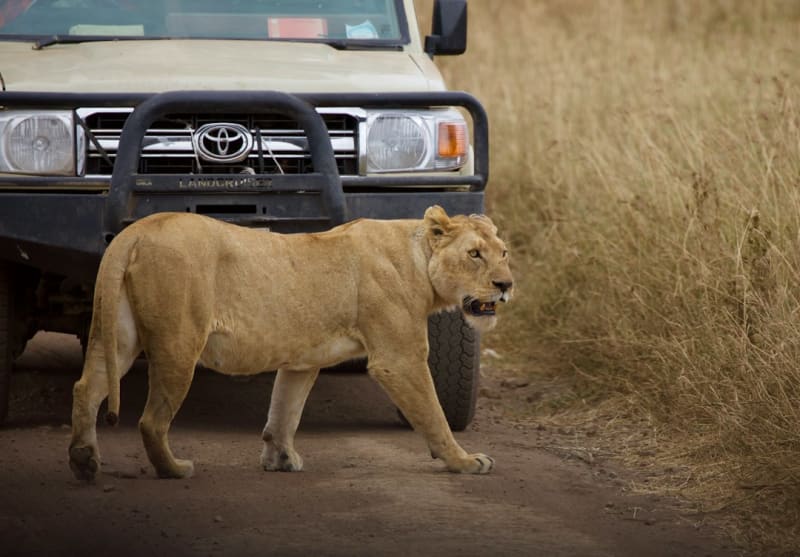
Eswatini’s conservation model includes state-managed protected areas, private reserves and conservation areas managed by Big Game Parks. Hlane Royal National Park is one of the country’s best-known wildlife destinations and is described in the available research as Eswatini’s largest protected area; lions have been reintroduced there alongside other large mammals [8]. The presence of lions in a reserve therefore reflects active wildlife management rather than a complete picture of the species’ historic distribution across the country.
The country’s conservation history also includes Mlilwane Wildlife Sanctuary, where Big Game Parks says environmental education and conservation-awareness work has been part of its approach for decades. The organisation reports that Mlilwane invested in the National Environmental Education Programme during the 1970s and continued school visits and public-awareness campaigns in later years [4]. Such work matters because long-term carnivore conservation depends not only on patrols and fences, but also on public understanding and local support.
Lions in Eswatini: what is known about status and numbers?
No source in the supplied research gives a current, independently verified national lion population estimate for Eswatini. That is an important evidence gap. A responsible account should distinguish between lions known to occur in particular reserves and a scientifically robust national population total.
The wider African context is clearer but still involves uncertainty. WWF reports an IUCN estimate of 23,000–39,000 wild lions, while noting that other recent data suggests the number may be closer to 20,000; WWF’s species summary gives a working population range of about 20,000–25,000 [6]. African Parks similarly states that fewer than 20,000 lions may remain across Africa and that the species has lost more than 80% of its historical range [5]. These continental estimates should not be used as a proxy for Eswatini’s population.
For Eswatini, the most useful conservation question is therefore not simply “how many lions are there?” It is whether reserves can maintain viable groups, whether prey and habitat are sufficient, whether lions can be monitored consistently, and whether conflict or illegal killing is being reduced. The IUCN Cat Specialist Group identifies effective protected-area management, community-based conservation, mitigation of human–lion conflict and improved monitoring as core conservation priorities [1].
The main threats to lions in Eswatini
Habitat loss and fragmentation
Eswatini’s biodiversity faces pressure from expanding agriculture, urbanisation, settlement development, plantation agriculture, bush-clearing and invasive plants [2][7]. IUCN’s protected-area assessment reports that 80% of Eswatini is infested with at least one invasive plant species, while fires and habitat alteration add further ecological pressure [2]. For lions, fragmented habitat can reduce access to prey and restrict movement between populations.
Fragmentation is especially important for a wide-ranging carnivore. The African Lion Working Group’s conservation guidelines identify habitat degradation, habitat loss, reduced prey, agricultural encroachment, livestock competition and unsustainable local hunting as threats to lions across Africa [3]. These pressures may be expressed differently in Eswatini’s reserves than in larger transfrontier landscapes, but they remain relevant to the quality and connectivity of lion habitat.
Human–lion conflict
Lions can come into conflict with people when they move near settlements or livestock. The IUCN Cat Specialist Group recommends livestock-management measures, appropriate problem-animal control and mechanisms for compensating livestock losses as ways to reduce human–lion conflict [1]. The practical objective is to prevent a livestock incident from becoming a retaliatory killing, while also ensuring that affected households are not left to carry the full cost of living beside wildlife.
The research excerpt from the Eswatini-based EWT material reports 326 incidents of human-caused mortality involving 426 individual lions between 2010 and 2023 [9]. Because the supplied extract does not identify the full study scope or methodology, this figure should not automatically be presented as a confirmed national Eswatini total. It does, however, underline why systematic reporting of causes of death and location is essential.
Snaring, prey depletion and illegal killing
Snaring is a serious risk for lions in landscapes where wire snares are set for other wildlife. WWF explains that declining prey populations can push lions into conflict with people and that lions may become caught in snares intended for bushmeat species, sometimes suffering severe injuries even when they escape [6]. The African Lion Working Group also lists ineffective protected-area protection, poor population monitoring and unsustainable hunting among the threats requiring management attention [3].
Eswatini’s broader biodiversity assessment identifies unsustainable harvesting of plant and animal species, including harvesting linked to medicinal use and charcoal production, as conservation pressures [2]. These activities do not all target lions directly, but they can degrade habitat, reduce prey or increase contact between people and wildlife.
Climate and environmental change
The supplied research identifies wildfires, invasive species, habitat degradation and land-use change as major pressures on Eswatini’s biodiversity [2]. Climate-related stress can intensify these problems by affecting water availability, vegetation and prey. However, the research provided does not support a quantified estimate of climate change’s specific effect on Eswatini’s lions, so the likely relationship should be described as a management concern rather than a measured national trend.
What is being done to conserve lions?
Protected-area management
Protected areas remain the foundation of lion conservation in Eswatini. IUCN’s State of Protected and Conserved Areas report records 15 protected areas covering 738 km², together with eight sites designated as Other Effective Area-Based Conservation Measures, or OECMs, in 2021. Those OECMs covered approximately 80 km² [2]. The figures describe the national protected and conserved-area system, not lion habitat specifically.
The Strengthening the National Protected Areas System project operated in Eswatini from 2014 to 2021. UNDP established a category for informal, non-gazetted conservation areas in 2018, and the project began certifying informal conservation areas as OECMs in 2021 [7]. This approach is relevant to lions because conservation outside conventional national parks can help maintain habitat and build wider ecological networks, provided sites have effective, demonstrated management.
Monitoring, law enforcement and response
Reliable monitoring is necessary to establish whether lions are increasing, declining or simply moving between reserves. The African Lion Working Group lists lack of knowledge and monitoring of lion populations as a direct conservation challenge [3]. In practice, monitoring can include sightings, spoor records, carcass investigations, prey surveys and, where scientifically justified, photographic identification or GPS collars. The supplied research does not document a current national lion-collaring programme in Eswatini, so travellers should not assume that every lion seen on safari is individually monitored.
Law enforcement remains important for preventing snaring, illegal hunting and other wildlife crime. Eswatini’s conservation financing system includes the Eswatini Environmental Fund, operated by the Ministry of Tourism and Environmental Affairs. The fund is capitalised through government concessions, environmental fines and grants from development partners [2]. Funding is not automatically the same as adequate funding: a survey reported by Conservation Mag found that 85% of protected-area stakeholders considered the areas where they worked insufficiently funded to meet conservation goals [10].
Regional conservation cooperation
Lions and their prey do not recognise national borders. The Eswatini National Trust Commission collaborates with governments and conservation organisations in Mozambique and South Africa on conservation initiatives [2]. Regional cooperation can support landscape planning, wildlife management and the exchange of expertise, although the research supplied does not quantify a specific cross-border lion programme or its results.
Community conservation and tourism’s role
Communities are central to lion conservation wherever livestock, farms and wildlife share a landscape. The IUCN Cat Specialist Group recommends community engagement and benefit-sharing alongside conflict mitigation [1]. Measures may include better livestock husbandry, rapid response to conflict, transparent reporting, fair compensation where schemes exist, and local employment in conservation. None of these should be presented as a universal solution: their effectiveness depends on local conditions, reliable funding and trust between communities, reserve managers and authorities.
Big Game Parks reports that its conservation model includes cultural tourism, conservation-awareness campaigns and the sale of surplus game meat from reserves. The organisation says that successful conservation can create surplus animals within reserves with hard boundaries, and that affordable venison may reduce incentives for some forms of poaching [4]. This is an organisational account of its approach, not independent evidence that the measure has reduced lion poaching or improved lion numbers.
Tourism can contribute through park fees, accommodation, guiding, employment, conservation levies and visitor spending, but the route from a safari booking to lion protection is not always automatic. Travellers should ask operators how money is distributed, whether local people benefit and whether the reserve publishes conservation or community results. Visitors can book conservation-supporting safaris on SafariFind, while still checking each operator’s claims and policies before paying.
A guide to community conservancies in Eswatini provides useful wider context for understanding how local participation can fit into the country’s conservation landscape. A lion safari should be viewed as one part of that system, not as proof that conservation is succeeding everywhere.
Results and setbacks: a balanced assessment
| Area | What the research supports | What remains uncertain or difficult |
|---|---|---|
| Protected areas | Eswatini has 15 protected areas covering 738 km², plus eight OECM sites reported in 2021 [2]. | The research does not provide a lion-specific assessment of habitat quality or connectivity. |
| Conservation systems | The SNPAS project expanded recognition of informal conservation areas, and the Eswatini Environmental Fund combines several funding sources [2][7]. | Stakeholder survey evidence indicates that protected-area funding remains inadequate for many conservation goals [10]. |
| Public engagement | Big Game Parks reports long-running education, school-visit and awareness activities [4]. | The supplied research does not measure the effect of these campaigns on attitudes or lion mortality. |
| Lion outlook | Globally, protected areas and legal protection have prevented more severe declines, according to the IUCN Green Status assessment [1]. | Lions remain Vulnerable, and the IUCN assesses the species as Largely Depleted with no expected significant recovery within the next decade under current and planned actions [1][6]. |
The fairest conclusion is cautious optimism. Eswatini has protected areas, conservation organisations, public-awareness work, funding mechanisms and regional links that can support lions. At the same time, there is no verified national 2026 lion estimate in the supplied evidence, funding is widely perceived as insufficient, and habitat change and human-caused mortality remain ongoing concerns.
How travellers can help responsibly
- Choose transparent operators: Ask whether park fees, conservation levies or donations reach the reserve and whether local communities receive measurable benefits.
- Respect wildlife space: Do not pressure guides to approach lions, block their movement or create unsafe vehicle gatherings.
- Do not request sensitive information: Avoid sharing exact locations of vulnerable animals or asking guides to reveal patrol or security details.
- Support credible local conservation: Prefer organisations and reserves that explain their governance, monitoring methods, community relationships and use of funds.
- Keep the wider ecosystem in view: Responsible African elephant conservation in Eswatini and black rhino conservation depend on many of the same fundamentals: secure habitat, capable management, community support and reliable financing.
- Report concerns through proper channels: If you witness harassment, suspected snaring or unsafe wildlife conduct, report it to the reserve or operator rather than confronting people yourself.
Eswatini’s lions do not need exaggerated population claims to justify protection. They need evidence-led monitoring, well-managed protected areas, credible community benefits and sustained investment. Those priorities are also what make a wildlife safari meaningful: visitors can enjoy a lion safari while helping create the financial and public support on which conservation depends.
Frequently Asked Questions
How many lions are there in Eswatini in 2026?
The available research does not provide a verified national lion population estimate for Eswatini in 2026. Lions are confirmed in protected wildlife areas, including Hlane Royal National Park, but reserve records should not be treated as a national total [8].
Are lions endangered in Eswatini?
There is no separate Eswatini Red List category established in the supplied research. Across Africa, lions are classified as Vulnerable, and the IUCN Green Status assessment describes the species as Largely Depleted [1][6].
Where can you see lions in Eswatini?
Hlane Royal National Park is identified in the supplied research as a protected area where lions have been reintroduced [8]. Sightings are never guaranteed and should not be confused with evidence of a national population estimate.
What are the biggest threats to lions in Eswatini?
The main concerns are habitat loss and fragmentation, declining or competing prey resources, human–lion conflict, snaring and inadequate conservation funding. Eswatini’s wider biodiversity also faces invasive plants, wildfires and unsustainable harvesting [1][2][3][6].
Does tourism help lion conservation in Eswatini?
Tourism can support conservation through park fees, employment, guiding, accommodation and visitor spending, but the research does not show that every booking directly funds lions. Travellers should ask operators how revenue is distributed and what conservation results are reported.
What is Eswatini doing to protect lion habitat?
Eswatini maintains a protected-area network and has recognised informal conservation areas as OECMs. The country’s SNPAS project helped expand the national conservation footprint, while the Eswatini Environmental Fund combines government, fine and development-partner funding sources [2][7].
How does human–lion conflict affect conservation?
Livestock losses and the risk posed by lions near settlements can lead to retaliatory killing. The IUCN recommends improved livestock management, appropriate problem-animal control, community engagement and compensation mechanisms where possible [1].
Are lions affected by poaching in Eswatini?
Lions can be affected directly by illegal killing and indirectly by snares set for other wildlife or by the depletion of prey. The available research does not provide a verified Eswatini lion-poaching total, but it identifies snaring, prey loss and weak protection as important African lion threats [1][3][6].
Why is lion monitoring important in Eswatini?
Monitoring establishes population trends, identifies causes of death, tracks movements and helps managers respond to conflict. The African Lion Working Group identifies insufficient knowledge and monitoring as continuing conservation challenges [3].
How can visitors support lion conservation responsibly?
Choose transparent safari operators, follow wildlife-viewing rules, avoid pressuring guides for close sightings, do not share sensitive animal locations and support reserves or organisations that explain their conservation and community programmes.