 Ask Tembo
Community Conservancies in Namibia: Conservation Guide 2026

Namibia's communal conservancies give rural communities legal rights to manage wildlife and natural resources, linking conservation with tourism, employment and local development. In 2026, the Namibia for Life initiative secured N$1 billion in long-term conservation financing, while human-wildlife conflict, funding resilience and governance remain ongoing challenges.
Last reviewed July 2026. Conservation data changes — see the cited sources for the latest figures.
Quick answer: what are Namibia's community conservancies?
Namibia's community conservancies are legally recognised communal-area institutions through which rural communities manage wildlife and natural resources, generate income from tourism and sustainable use, and reinvest benefits locally. The model developed after the 1996 Nature Conservation Amendment created a framework for communities to receive wildlife-use rights and establish voluntary communal governing bodies.[1]
In 2026, Namibia's community-conservation model received a major financing commitment: the Government of Namibia and partners announced N$1 billion in long-term funding through the Namibia for Life initiative. The financing is intended to support conservation operations, community development, governance, sustainable land use and livelihood diversification, but it does not remove persistent challenges such as livestock losses, climate pressure, uneven economic returns and dependence on technical support.[3][4]
Why community conservancies matter in Namibia
Namibia's conservancies address two linked problems: rural poverty and the historical absence of secure wildlife-management rights for many communities living on communal land. Before communities had a formal stake in wildlife, animals on public or communal landscapes could impose costs without reliably creating local benefits. Namibia's community-based natural resource management, or CBNRM, programme sought to change that relationship by devolving use and management rights.[1]
The legal framework dates from the mid-1990s. The Nature Conservation Amendment of 1996 enabled local communities to establish conservancies, manage wildlife on communal land and work with private tourism operators.[1][5] A conservancy is therefore more than a tourism destination: it is a local governance structure responsible for conservation planning, wildlife management, benefit distribution and engagement with traditional authorities, public agencies, NGOs and private-sector partners.[8]
Conservancies also extend conservation beyond national-park boundaries. They can act as buffer landscapes around protected areas and help maintain connectivity for wide-ranging and migratory species. Research on Namibia's CBNRM model describes this community-managed land as particularly important for species such as savannah elephants, whose movements are not confined to park borders.[1] For a closer look at the species-specific picture, see SafariFind's African Elephant Conservation in Namibia: 2026 Guide.
How the conservancy model works
Communities form a governing body, agree rules for natural-resource management and oversee how income and other benefits are used. Depending on the conservancy and its agreements, revenue can come from tourism partnerships, trophy hunting, own-use hunting, the sale of animals and other sustainable natural-resource activities.[5][8]
Tourism joint ventures are a central mechanism. A conservancy may provide land, wildlife habitat and local oversight, while a private company supplies capital, operating expertise, marketing and hospitality management. Older programme data recorded 20 formal joint ventures by the end of 2008; joint-venture lodges generated N$16.95 million that year, representing 52% of conservancy income in the cited dataset.[8] Those figures are historical rather than a 2026 national total, but they illustrate why long-term, well-governed partnerships have mattered to the model.
Benefits do not consist only of cash payments. Conservancy income has supported community projects including wells and education, while own-use hunting can provide legally obtained meat for members and for community events.[1][8] Research cited by the Mercatus Center reported that 30 conservancies were harvesting game and distributing meat to members in the late 2000s.[8]
The main threats facing community conservancies
Wildlife crime and limited enforcement capacity
Poaching remains a conservation and governance concern, particularly for species whose protection generates limited direct revenue for communities. Namibia's conservation-finance research identifies donor support for anti-poaching work involving elephants and rhinoceroses as an important funding use because international agreements can restrict revenue-generation options for these species.[9]
Community-based monitoring can strengthen thinly staffed enforcement networks, especially across large landscapes. In Kunene, GPS training for 26 conservancy rangers and two Namibian police officers was associated with a 44% reduction in discovered poaching events in communal conservancies and the Palmwag Tourism Concession in 2015 compared with 2014.[6] This is a place-specific historical result, not evidence that poaching has been eliminated nationally. Travellers interested in enforcement systems can read Anti-Poaching in Namibia: Wildlife Crime & Conservation 2026.
Human-wildlife conflict
Human-wildlife conflict is one of the most pressing current challenges in communal conservancies. CCFN reports that communities living near lions, hyenas and leopards can face livestock losses that threaten household income and weaken local support for conservation.[11] Conflict also affects relationships with elephants and other large herbivores when wildlife competes with people and livestock for water, crops or grazing, although the supplied research does not provide a single national conflict total.
The response must be practical and community-led. The Poverty-Oriented Support to Community Conservation in Namibia project, known as POSCCIN, is described as supporting coexistence measures in response to predator-related livestock losses.[11] The broader lesson is important: conservation incentives are unlikely to remain credible if local households carry wildlife-related costs without timely support, risk reduction or a fair share of benefits.
Habitat pressure, drought and climate resilience
Communal conservancies operate in landscapes where conservation, livestock production and household livelihoods overlap. WWF Namibia's 2022–2026 strategy identifies climate change and systemic shocks as risks to ecological and economic resilience, and calls for community conservation to expand beyond communal areas to freehold farms and national parks.[2]
Water infrastructure can support both people and wildlife, but it must be planned carefully so that it does not increase conflict, concentrate animals in vulnerable areas or intensify pressure on grazing. WWF describes tourism-funded solar water pumps serving livestock, elephants and people in community landscapes.[4] The research does not establish that every conservancy has equivalent infrastructure, so local conditions vary considerably.
Uneven benefits and financial vulnerability
Conservancies have not all achieved the same economic outcomes. Historical research found that some were financially self-sufficient while others were still developing, and that economic expectations were sometimes unrealistic or poorly matched to local circumstances.[5][8] Tourism income can also be vulnerable to external shocks: ODI reports that donor funding helped buffer communities and support ranger operations during the collapse in tourism associated with the COVID-19 pandemic.[9]
Funding dependence is another structural concern. A conservation report noted that NACSO and partners had limited financial and human resources to provide the necessary support to developing conservancies and community forests, while funding had depended heavily on donors including USAID, the Millennium Challenge Corporation and WWF.[6] Long-term finance can help, but it must be paired with transparent governance, local accountability and reliable technical assistance.
What is being done in 2026?
Namibia for Life and long-term conservation finance
On 20 May 2026, the Government of Namibia and WWF announced Namibia for Life, described by WWF as Africa's first Project Finance for Permanence initiative.[4] On 26 May 2026, the Community Conservation Fund of Namibia reported that the partnership had secured N$1 billion in long-term conservation financing.[3]
The initiative is designed to provide more predictable support for community-led conservation. Its proposed Socio-Economic Development Fund is intended to help conservancies and rural communities develop small businesses, strengthen local enterprises, create employment and diversify income connected to conservation and sustainable natural-resource management.[3] The initiative is intended to support up to 100 conservancies managing up to 20 million hectares, according to WWF; this is a programme ambition, not a claim that all those conservancies or hectares are already covered.[4]
Government, NACSO, WWF and community institutions
The Ministry of Environment, Forestry and Tourism, the Namibian Association of CBNRM Support Organisations (NACSO), WWF Namibia, the Community Conservation Fund of Namibia and conservancy representatives all contribute to the wider support system. The model depends on partnerships rather than a single organisation operating every conservancy.[3][4][9]
CCFN reports that Namibia for Life will strengthen extension services and technical support in governance, financial management, conservation planning and sustainable land use.[3] In 2026, CCFN also reported digital Community Hubs using VSAT satellite technology in Otjiu-West and Orupembe conservancies in the Kunene Region, improving access to communications in remote areas.[11]
A question about Namibia? Ask Tembo
Rangers, monitoring and species protection
Local monitoring is one of the model's practical strengths. Community members can contribute knowledge of wildlife movements, report threats and support official enforcement. The Kunene GPS-training example demonstrates how equipment, training and coordination with police can improve field operations, although a single year-on-year result should not be generalised to every region.[6]
Black-rhino protection also illustrates the importance of custodianship, monitoring and long-term local commitment. Save the Rhino reported the launch of the Black Rhino Association of Namibia and its first annual general meeting in May 2026, with representatives including communal and freehold custodians, Namibia Nature Foundation, WWF Namibia, Save the Rhino Trust and the Ministry of Environment, Forestry and Tourism.[10] Read more in SafariFind's Black Rhino Conservation in Namibia: 2026 Guide.
Results and setbacks: what the evidence shows
| Area | Evidence from the research | How to interpret it |
|---|---|---|
| Wildlife recovery | In the Caprivi region, elephant numbers rose from about 100 to more than 1,000 between 2001 and 2008; the source attributes much of this success to CBNRM.[1] | A significant historical regional result, not a current national population estimate. |
| Economic contribution | WWF Namibia's 2022–2026 strategy gave an approximate 2020 annual economic contribution of N$933 million for conservancies and set recovery to the 2019 level as a 2026 target.[2] | A strategic-plan baseline and target; the supplied research does not confirm the 2026 outcome. |
| Employment | Historical research reported nearly 800 full-time and more than 5,000 part-time jobs associated with CBNRM by 2008.[8] | Useful evidence of livelihood impact, but too old to represent current employment. |
| Protected landscapes | WWF reported that 42% of Namibia was under some form of conservation management in its 2020 baseline, including communal conservancies, parks, freehold conservancies, tourism concessions and some community forests.[2] | The figure combines several categories and should not be read as the percentage covered by communal conservancies alone. |
| Long-term finance | Namibia for Life partners announced N$1 billion in long-term conservation financing in May 2026.[3] | A major financing milestone, but implementation, distribution and measurable outcomes still need monitoring. |
Overall, the evidence supports a qualified conclusion. Namibia's conservancies have helped create wildlife incentives, local institutions, tourism partnerships and conservation employment. They have also contributed to wildlife recovery in some landscapes. However, success is uneven, historical datasets should not be presented as current national results, and the model remains exposed to conflict, drought, funding disruption and governance capacity constraints.[1][2][6][8][9][11]
Community conservancies and responsible safari tourism
When a lodge operates through a genuine conservancy partnership, visitor spending can help support employment, local enterprises, conservation operations and community projects. WWF describes tourism lodges on community land funding solar water pumps, while Namibia's CBNRM research records tourism income being reinvested in community priorities.[1][4]
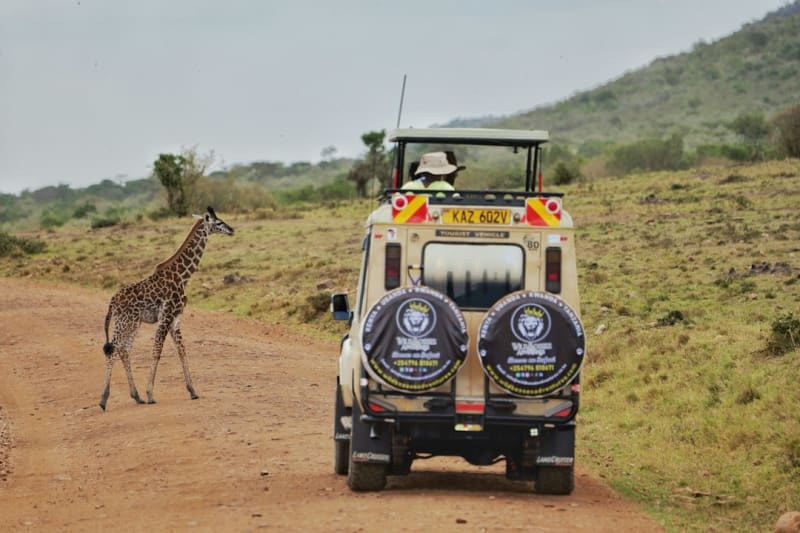
Travellers should nevertheless avoid assuming that every lodge automatically delivers the same benefits. Ask the operator which conservancy it works with, whether the relationship is a formal joint venture or concession, how local employment is supported, and whether conservation and community contributions are reported transparently. A safari vehicle entering communal wildlife habitat should follow local rules, maintain respectful distances and avoid pressuring guides to create harmful wildlife encounters.
Road access, remoteness and seasonal conditions affect safari planning. Travellers considering self-drive routes should review Namibia safari car rental routes, costs and risks, particularly before travelling through sparsely serviced communal landscapes. Visitors can book conservation-supporting safaris on SafariFind by comparing operators and asking how their itineraries contribute to local conservation partnerships.
How travellers can help responsibly
- Choose locally connected operators: Prefer itineraries that identify the conservancy, community partner or local project receiving support rather than using vague "eco-safari" claims.
- Spend locally: Use community camps, local guides, craft enterprises and services where quality and safety are appropriate. This can broaden the benefits beyond a single lodge contract.
- Respect wildlife rules: Do not request unsafe approaches, off-road driving or predator baiting. Follow guides' instructions and remember that wildlife is a community resource, not a visitor entitlement.
- Support credible funds: If donating, check the organisation's legal identity, project location, governance information and reporting before sending money or equipment.
- Do not photograph sensitive enforcement activity: Avoid sharing ranger locations, rhino sightings or anti-poaching patrol details publicly when doing so could expose wildlife or staff to risk.
- Travel with realistic expectations: Conservancies are working landscapes, not fenced wildlife exhibits. Livestock, villages, predators, drought and tourism all coexist there.
Frequently Asked Questions
Frequently Asked Questions
What is a community conservancy in Namibia?
A community conservancy is a communal-area institution through which local residents manage wildlife and natural resources, develop income opportunities and oversee conservation benefits. Namibia's 1996 legal framework enabled communities to establish conservancies and receive wildlife-use rights.[1][5]
How many community conservancies are there in Namibia in 2026?
The supplied research does not provide a definitive current 2026 national count. Historical sources recorded 53 registered conservancies and 23 emerging conservancies at the end of 2008, while Namibia for Life is designed to support up to 100 conservancies managing up to 20 million hectares.[4][8]
How do Namibian conservancies make money?
Income can come from tourism joint ventures, trophy hunting, own-use hunting, animal sales and other sustainable natural-resource activities. Tourism partnerships are particularly important, although returns vary between conservancies.[5][8]
Do community conservancies help protect elephants in Namibia?
They can help by extending wildlife management beyond national parks, improving local monitoring and creating incentives to retain wildlife. In the Caprivi region, elephant numbers increased from about 100 to more than 1,000 between 2001 and 2008, with CBNRM identified as a major contributor.[1]
What are the biggest threats to Namibia's community conservancies?
The main challenges are human-wildlife conflict, wildlife crime, habitat and land-use pressure, drought and climate-related shocks, uneven tourism income, governance capacity and dependence on external funding.[2][6][9][11]
Does safari tourism benefit Namibian communities?
It can. Formal tourism partnerships generate income and employment, and tourism-linked funds have supported community projects such as water infrastructure. Benefits depend on the specific conservancy agreement, local employment and how transparently revenue is managed.[1][4][8]
What is Namibia for Life?
Namibia for Life is a long-term conservation-finance initiative launched by the Government of Namibia and WWF in May 2026. Partners reported securing N$1 billion to support community conservation, ecosystem protection, livelihoods and technical capacity.[3][4]
What is the role of NACSO in Namibia's conservancies?
NACSO is the Namibian Association of CBNRM Support Organisations. It is part of the wider support system that helps conservancies with governance, natural-resource management, monitoring and development, alongside government, NGOs and other partners.[3][6][9]
Can travellers visit community conservancies in Namibia?
Yes, safari lodges and tourism enterprises operate through partnerships in some communal conservancies. Visitors should confirm which conservancy they are visiting, follow local wildlife rules and ask operators how tourism supports community and conservation outcomes.[1][4][8]
How can tourists support Namibia's conservancies?
Choose transparent community-linked operators, spend with local enterprises, follow wildlife guidelines, avoid sharing sensitive rhino or ranger-location information and consider donating only to credible organisations with clear reporting.
Are Namibian conservancies completely financially self-sufficient?
No. Some conservancies have achieved financial self-sufficiency or moved towards it, but historical research found varied results, and conservation organisations have also depended heavily on donors and external technical support.[6][8]
How are community conservancies different from national parks?
National parks are government-managed protected areas, while communal conservancies are community-governed institutions operating on communal land under Namibia's wildlife and natural-resource framework. Conservancies can complement parks by providing buffer areas and wider habitat for mobile wildlife.[1][5]
Trips that match this guide